New Jersey seller costs, 2026
NJ Mansion Tax 2026: the Graduated Percent Fee, Who Pays It, and a Realty Transfer Fee Calculator
New Jersey’s mansion tax is 1% to 3.5% of the entire sale price on homes that sell for more than $1,000,000, and since July 10, 2025 the seller pays it, on top of the base realty transfer fee. On a $1,200,000 sale that is $12,000 of mansion tax plus $11,995 of transfer fee: $23,995 owed at closing.
The short answer, as of October 15, 2026
1% to 3.5%
of the whole price, over $1,000,000
Five bands, from 1% up to $2,000,000 to 3.5% above $3,500,000. The rate is applied to the entire price, so the fee jumps at each line.
Seller pays
since July 10, 2025
P.L.2025, c.69 moved the fee from the buyer to the seller and replaced the flat 1% with the graduated rates. The seller also owes the base realty transfer fee.
+$20,006
for the first dollar over $2,000,000
State fees go from $41,675 at $2,000,000 to $61,681 at $2,000,001. A seller needs $2,020,668 to keep as much.
Every figure on this page is arithmetic on the New Jersey Division of Taxation’s published schedules, checked against the Division’s own worked answers ($1,910 on a $325,000 sale, $475 for a qualifying senior selling at $280,000, and a $68,750 Graduated Percent Fee on $2.75 million). It explains the law; it is not tax or legal advice, and your closing attorney or title company calculates the fee on your deed.
NJ mansion tax rates for 2026
The Graduated Percent Fee replaced the old flat 1% buyer fee on July 10, 2025. The Division of Taxation’s memo of July 2, 2025 calls it “a straight application of a percentage of total consideration,” which means one rate times the whole price, with no marginal brackets.
| Sale price (consideration) | Rate on the whole price | Mansion tax in that band |
|---|---|---|
| $1,000,000 or less | None | $0 |
| $1,000,001 to $2,000,000 | 1% | $10,000 to $20,000 |
| $2,000,001 to $2,500,000 | 2% | $40,000 to $50,000 |
| $2,500,001 to $3,000,000 | 2.5% | $62,500 to $75,000 |
| $3,000,001 to $3,500,000 | 3% | $90,000 to $105,000 |
| Over $3,500,000 | 3.5% | $122,500 and up ($140,000 at $4 million) |
The fee applies to deeds for Class 2 residential property of one to four units, co-op units, Class 3A farm property that includes a home, and Class 4A commercial property other than industrial or apartment buildings. The property class is the one on the municipal tax list. The county recording officer collects the fee when the deed is offered for recording, together with the base realty transfer fee, and a Form RTF-1EE affidavit must be attached to every deed over $1,000,000.
Sources: the Division of Taxation realty transfer fee page (updated Sept. 28, 2026), the July 2, 2025 memo and P.L.2025, c.69.
Who pays the mansion tax in NJ?
The seller.P.L.2025, c.69, approved June 30, 2025, rewrote N.J.S.A. 46:15-7.2 to impose the fee “upon the grantor,” and it applies to transfers on or after July 10, 2025. From 2004 until then, the buyer paid a flat 1% on purchases over $1,000,000. The seller has always paid the base realty transfer fee, so today a seller over $1,000,000 pays both.
- A contract can move the cost, not the liability. The Division’s July 9, 2025 policy memo says contract provisions that allocate the fee differently “are private legal arrangements,” and its exemptions notice says the parties “are able to apportion or shift the burden of payment in their contract negotiations.” Legally, the seller still owes it, and only the seller can claim a refund.
- The recording date decides the rate. The same memo makes the date the deed is submitted to the county the operative date, not the contract or closing date.
- The 2025 grace period is over. Sellers whose contracts were fully signed before July 10, 2025 could claim back anything above 1% only if the deed was recorded by November 15, 2025. Every 2026 sale is on the new schedule.
- One state guide is out of date.The Division’s “Buying or Selling a Home in New Jersey” PDF (last modified August 12, 2025) still says buyers may pay an additional 1% fee. The Division’s memos and its realty transfer fee page, updated September 28, 2026, say the seller is statutorily responsible.
If you are the buyer, the statute leaves you with no state transfer fee on a home purchase, unless your contract shifts some of it to you. Read that clause with your attorney. For the rest of your cash to close, see the NJ buyer closing costs guide.
How to calculate the mansion tax and realty transfer fee
- Base realty transfer fee. For a price over $350,000, charge each slice of the price at its rate per $500: $2.90 on the first $150,000, $4.25 up to $200,000, $4.80 up to $550,000, $5.30 up to $850,000, $5.80 up to $1,000,000 and $6.05 above that. Sales of $350,000 or less use a lower schedule.
- Mansion tax.If the price is over $1,000,000, multiply the whole price by its band’s rate.
- Add them.That is the seller’s state transfer cost. County recording fees are separate.
| Slice of the price | Rate per $500 | Fee |
|---|---|---|
| First $150,000 | $2.90 | $870 |
| $150,000 to $200,000 | $4.25 | $425 |
| $200,000 to $550,000 | $4.80 | $3,360 |
| $550,000 to $850,000 | $5.30 | $3,180 |
| $850,000 to $1,000,000 | $5.80 | $1,740 |
| $1,000,000 to $1,200,000 | $6.05 | $2,420 |
| Base realty transfer fee | $11,995 | |
| Mansion tax, 1% of $1,200,000 | $12,000 | |
| Seller’s total | $23,995 |
What sellers owe at six price points
| Sale price | Base transfer fee | Mansion tax | Seller total |
|---|---|---|---|
| $835,000Bergen single-family median, Sept. 2026 | $7,676 | $0 | $7,676 |
| $1,200,000 | $11,995 | $12,000 (1%) | $23,995 |
| $1,500,000 | $15,625 | $15,000 (1%) | $30,625 |
| $2,100,000 | $22,885 | $42,000 (2%) | $64,885 |
| $2,750,000The Division's own example | $30,750 | $68,750 (2.5%) | $99,500 |
| $3,600,000 | $41,035 | $126,000 (3.5%) | $167,035 |
Standard sale, base fee from the Division’s per-$500 schedule, mansion tax from the July 2, 2025 memo. The Division’s memo uses the same $2.75 million example: $68,750 of Graduated Percent Fee “in addition to the other grantor fees.”
NJ realty transfer fee and mansion tax calculator
What the seller owes the state at closing
Type a sale price to see the base transfer fee, the mansion tax and the seller’s total. An estimate, not advice.
Whole dollars, from $1,000 to $50,000,000.
Who is selling?
Base realty transfer fee
$11,995
standard rates
Mansion tax (Graduated Percent Fee)
$12,000
1% of the whole $1,200,000
Seller’s total state fees
$23,995
2.00% of the price; leaves $1,176,005 before commission, payoff and other costs
The next line is $2,000,000. One dollar over it adds $20,006 to the seller’s state fees, because the higher rate applies to the whole price.
Show the per-$500 math for the base fee
| Part of the price | Rate per $500 | Fee |
|---|---|---|
| $0 to $150,000 | $2.90 | $870 |
| $150,000 to $200,000 | $4.25 | $425 |
| $200,000 to $550,000 | $4.80 | $3,360 |
| $550,000 to $850,000 | $5.30 | $3,180 |
| $850,000 to $1,000,000 | $5.80 | $1,740 |
| $1,000,000 to $1,200,000 | $6.05 | $2,420 |
Sales over $350,000 use the higher schedule for the whole price. Each band is charged per $500 or part of $500.
Estimate, not advice. Your closing attorney or title company calculates the fee on your deed, and county recording fees are separate. Rates: NJ Division of Taxation per-$500 realty transfer fee schedule and Graduated Percent Fee on the whole price, for deeds submitted for recording on or after July 10, 2025. The Graduated Percent Fee applies to residential (Class 2) property, co-op units, farm property with a home, and most commercial property; exempt transfers and other property classes are not modeled here. Not a rate quote, a loan offer, or tax or legal advice.
Selling over $1 million and buying your next home? Jimmy can run the purchase side of the numbers with you, from the proceeds you expect to the loan size that fits.
Call (718) 812-7798The $2 million cliff: where a higher price leaves you less
Because each rate applies to the whole price, the first dollar over a line costs thousands. The worst is $2,000,000: the mansion tax doubles from $20,000 to $40,000.02, and the seller’s total state fees jump by $20,006. Counting both fees, a seller needs $2,020,668 to keep as much as a $2,000,000 sale leaves. Any price in between nets less.
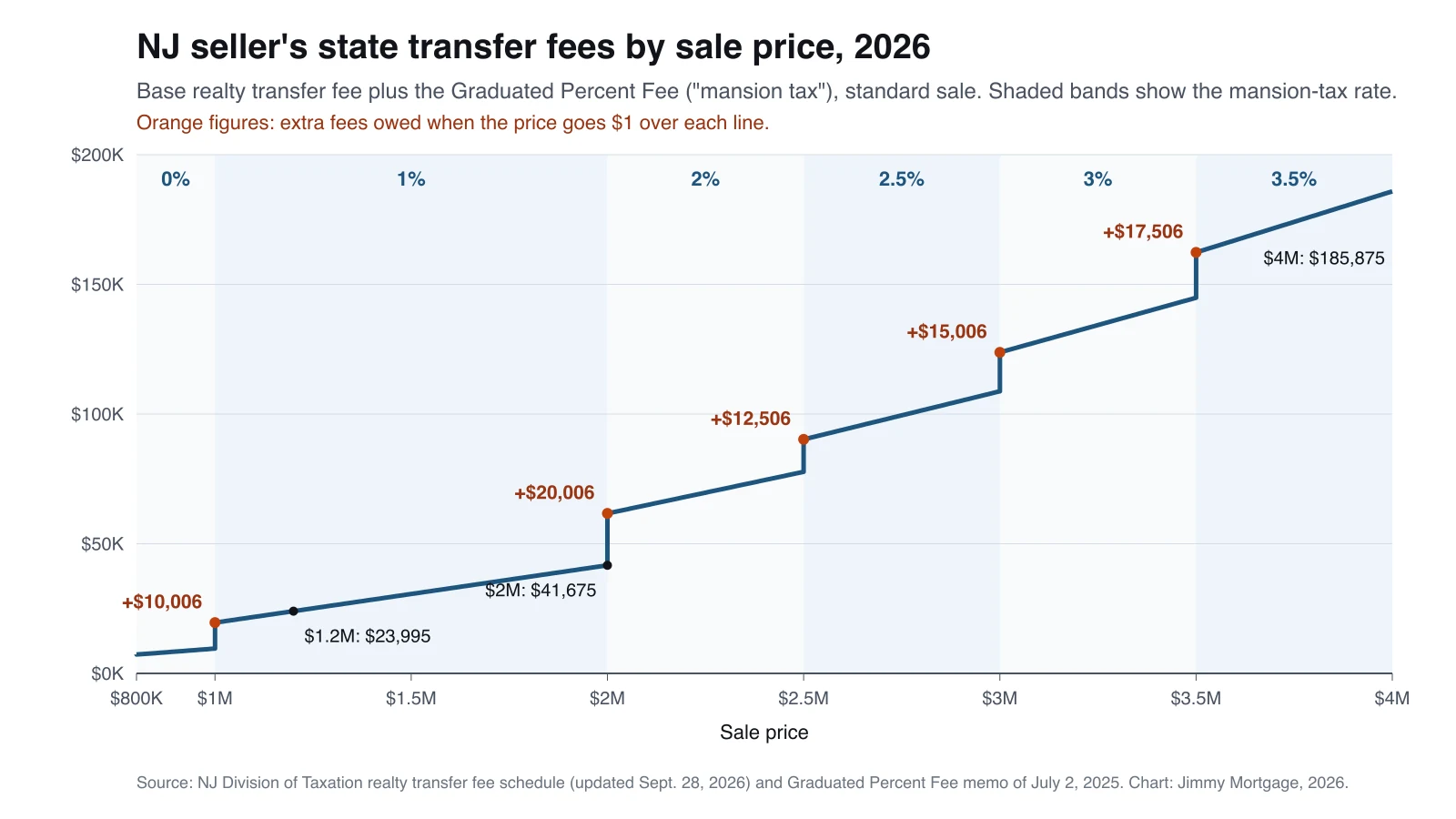
| Line | Jump | Price that nets the same |
|---|---|---|
| $1,000,000 | +$10,006 | $1,010,230 |
| $2,000,000 | +$20,006 | $2,020,668 |
| $2,500,000 | +$12,506 | $2,512,982 |
| $3,000,000 | +$15,006 | $3,015,664 |
| $3,500,000 | +$17,506 | $3,518,367 |
What this means in practice: list and negotiate with the line in view. An offer of $2,010,000 instead of $2,000,000 leaves the seller $10,321 less, not $10,000 more, after the two state fees. Run any figure through the calculator above before you set a price or counter. Commission, payoff and attorney fees come on top and are not modeled here.
Bergen County: who actually crosses $1 million
Jimmy’s office is in Paramus, so here is the mansion tax in Bergen terms.
- The typical Bergen house is under the line. New Jersey Realtors’ September 2026 report puts the Bergen County single-family median at $835,000, up 1.2% from a year earlier, and $885,000 for the year to date, up 4.1%. The townhouse and condo median was $527,000. A seller at $835,000 owes a base transfer fee of $7,676 and no mansion tax.
- About one sale in ten statewide is over $1 million. In fiscal year 2025, 10,917 of New Jersey’s 109,844 non-exempt Class 2 residential sales (9.9%) were over $1,000,000, and 2,206 (2.0%) were over $2,000,000, where the new higher rates now apply. The old 1% buyer fee raised $268,129,474 that year (unaudited), per the Treasury’s first Realty Transfer Fee Statistical Report.
- The loan side starts near the same number. The 2026 conforming loan limit for a one-unit home in Bergen County is $1,209,750, against a national baseline of $832,750. A buyer paying $1,500,000 with 20% down borrows $1,200,000, inside that limit; at $2,000,000 with 20% down the $1,600,000 loan is a jumbo loan. Where your loan lands decides which program fits, and that is the conversation to have before you write an offer near a mansion-tax line.
Exemptions, reduced rates and refunds
Three different things get called “exemptions.” They work differently, so it helps to keep them apart.
1. Deeds the mansion tax does not reach
- Property outside the covered classes: vacant land, qualified farmland, industrial property and apartment buildings.
- A sale to a 501(c)(3) organization.
- Deeds that are fully exempt from the realty transfer fee, listed on Form RTF-1EE: among them deeds between spouses or civil union partners, between parent and child, an executor’s distribution under a will or the intestacy laws, a deed recorded within 90 days of a divorce decree between the two spouses, a deed for less than $100, and a deed that only corrects an earlier one.
2. Reduced base fee for qualifying seniors, blind and disabled sellers
A seller who is 62 or older, legally blind, or permanently and totally disabled, who is a New Jersey resident and owns and lives in the one- or two-family home being sold, can claim lower base rates on Form RTF-1. On a $1,200,000 sale the base fee falls from $11,995 to $6,035, a $5,960 saving. It does not touch the mansion tax: Form RTF-1EE lists no age or disability exemption, so the $12,000 still applies and the total is $18,035. Sellers planning a move to a smaller home can see how the next purchase is financed on the downsizing mortgage page.
3. Refunds when the class is wrong
The fee follows the property class on the municipal tax list. If a seller believes the class is wrong after the appeal deadline, the Division’s guidance is to pay the fee and file a claim for refund, after which Division staff inspect the property. Refund claims under N.J.S.A. 46:15-7.2(c) must be filed within 90 days of paying the fee. Ask the assessor about the class before you list, not after you close.
Can you avoid the NJ mansion tax?
Not on a covered sale over $1,000,000 without an exemption: the county recording officer collects the fee before the deed is recorded. What a seller can do, legitimately:
- Price with the lines in view.$1,000,000 owes no mansion tax; $1,000,001 owes $10,000.01. Use the “price that nets the same” column above before you set a list price or counter an offer.
- Confirm the property class with the municipal assessor early, especially for mixed-use and farm property.
- Check the real exemptions above with your attorney, including the reduced base rates for qualifying seniors.
- Negotiate the contract. A clause can shift who bears the cost. It does not change the amount, and the Division treats it as a private arrangement.
Misstating the price is not a strategy. Form RTF-1EE warns that knowingly falsifying the consideration on a deed or affidavit is a fourth-degree crime, and the Division can assess any underpayment against the seller.
Other taxes and fees a New Jersey seller sees at closing
- Base realty transfer fee on every sale unless an exemption applies, with Form RTF-1 when a partial or full exemption is claimed.
- Graduated Percent Fee on covered sales over $1,000,000, with Form RTF-1EE.
- A GIT/REP form for every seller.New Jersey residents certify residency; nonresident sellers may have to make an estimated income tax payment at closing unless an exemption on the form applies. The Division’s seller guide explains which form you file.
- County recording fees for the deed, which are separate from the state fees above and not covered here.
Sources
- NJ Division of Taxation, Realty Transfer Fee page: base fee schedules, Graduated Percent Fee rates, seller responsibility (last updated Sept. 28, 2026)
- NJ Division of Taxation, Realty Transfer Fee FAQs: per-$500 rates, partial exemptions, worked answers ($325,000 standard sale $1,910; $280,000 senior sale $475)
- Division of Taxation memo, July 2, 2025: Amendments to Graduated Percent Fee on realty transfers over $1 million ($2.75 million example, $68,750)
- Division of Taxation memo, July 9, 2025: Clarification on Graduated Percent Fee implementation (recording date, contract allocation)
- Division of Taxation, General Information on the Graduated Percent Fee (covered classes, 501(c)(3) exemption, 90-day refund rule, classification refunds)
- Form RTF-1EE, Affidavit of Consideration for Graduated Percent Fee and Form RTF-1, Affidavit of Consideration for Use by Seller (partial exemption rules)
- P.L.2025, c.69 (A5804), approved June 30, 2025, effective for transfers on or after July 10, 2025
- NJ Treasury, Realty Transfer Fee Statistical Report for Fiscal Years Through FY 2025 (December 2025): FY2025 Class 2 sales by price band and collections
- New Jersey Realtors, Local Market Update for September 2026, Bergen County (current as of Oct. 9, 2026)
- FHFA, conforming loan limit values for 2026 ($832,750 baseline) and the 2026 county list (Bergen County one-unit limit $1,209,750)
- NJ Division of Taxation, Buying or Selling a Home in New Jersey (GIT/REP forms; last modified Aug. 12, 2025)
Sources were opened and checked on October 15, 2026. Fee schedules can change by law. This page explains New Jersey’s published fees; it is not tax or legal advice, not a rate quote, and not a commitment to lend. Your closing attorney or title company calculates the fee due on your deed.
Frequently asked questions
What is the NJ mansion tax rate in 2026?
New Jersey's mansion tax, officially the Graduated Percent Fee, is 1% of the entire price on a sale over $1,000,000 up to $2,000,000; 2% over $2,000,000 up to $2,500,000; 2.5% over $2,500,000 up to $3,000,000; 3% over $3,000,000 up to $3,500,000; and 3.5% over $3,500,000. These rates took effect for deeds submitted for recording on or after July 10, 2025, under P.L.2025, c.69, and the Division of Taxation's realty transfer fee page, last updated Sept. 28, 2026, shows the same schedule. It is charged in addition to the base realty transfer fee.
Who pays the mansion tax in NJ, the buyer or the seller?
The seller. Since July 10, 2025 the statute puts the Graduated Percent Fee on the grantor, the seller, and the seller already owed the base realty transfer fee. Before that date the buyer paid a flat 1% on purchases over $1 million. The Division of Taxation says a contract that allocates the fee differently is a private arrangement between buyer and seller, so a contract can shift who writes the check, but the legal liability stays with the seller.
How do I calculate the New Jersey mansion tax and realty transfer fee?
Multiply the whole sale price by the mansion-tax rate for its band, then add the base realty transfer fee, which is charged per $500 of price in bands. On a $1,200,000 standard sale the mansion tax is 1% of $1,200,000, or $12,000, and the base fee is $11,995: $870 on the first $150,000, $425 to $200,000, $3,360 to $550,000, $3,180 to $850,000, $1,740 to $1,000,000 and $2,420 on the last $200,000. The seller owes $23,995 in all. The calculator on this page does the same arithmetic for any price.
Is the NJ mansion tax charged only on the amount over $1 million?
No. The rate applies to the entire price, not the slice above the threshold. That is why the fee jumps at each line: a $2,000,000 sale owes $20,000 of mansion tax and a $2,000,001 sale owes $40,000.02. Counting the base fee too, a seller needs a price of about $2,020,668 just to keep as much as a $2,000,000 sale leaves after the two state fees.
Which properties and transfers are exempt from the NJ mansion tax?
The fee applies to Class 2 residential property of one to four units, co-op units, Class 3A farm property that includes a home, and Class 4A commercial property other than industrial or apartment buildings. Vacant land, qualified farmland, industrial property and apartment buildings are outside it. It also does not apply when the buyer is a 501(c)(3) organization, and the total exemptions on Form RTF-1EE cover deeds such as transfers between spouses or civil union partners, between parent and child, an executor's distribution under a will, and a deed recorded within 90 days of a divorce decree between the two spouses. Your closing attorney decides which form and exemption apply to your deed.
Can you legally avoid the mansion tax in New Jersey?
Not on a covered sale over $1,000,000 that has no exemption; the county will not record the deed until the fee is paid. What sellers can legitimately do is know where the lines are (a $1,000,000 sale owes no mansion tax, $1,000,001 owes $10,000.01), confirm the property class with the municipal assessor before listing, check whether a real exemption applies, and negotiate the contract, which can shift who bears the cost but not whether it is owed. If a fee is paid on a property later found to be in an exempt class, the Division says to file a refund claim, and refund claims must be filed within 90 days of payment.
Do seniors pay less realty transfer fee in New Jersey?
Yes, on the base fee only. A seller who is 62 or older, legally blind, or permanently and totally disabled, is a New Jersey resident, and owns and lives in the one- or two-family home being sold can claim reduced rates on Form RTF-1; joint owners must all qualify, except a married or civil union couple holding as tenants by the entirety, where one qualifying spouse is enough. On a $1,200,000 sale the base fee drops from $11,995 to $6,035. The Graduated Percent Fee is separate and Form RTF-1EE lists no age or disability exemption from it, so the $12,000 mansion tax still applies.
Did the NJ mansion tax change in 2026?
No change to the rates or to who pays has been made since July 10, 2025. The Division of Taxation's realty transfer fee page, last updated Sept. 28, 2026, still lists the July 2025 schedule with the seller statutorily responsible. The 2025 law's grace period, which let sellers with contracts signed before July 10, 2025 claim back anything above 1% if the deed was recorded by Nov. 15, 2025, has ended.
Keep planning
Buying a luxury home in Bergen County
Financing above the $1,209,750 limit, and what a high-value file looks like.
Continue planningJumbo loans
Loans above the conforming limit, down payment and documentation basics.
Continue planningConventional vs jumbo
Where the conforming limit sits and how the two loan types compare.
Continue planningDownsizing in New Jersey
Selling the family home and financing the next, smaller one.
Continue planningNJ buyer closing costs, 2026
The buyer's side of the closing table, line by line.
Continue planningHow much house can I afford?
Turn a price into a monthly payment before you make an offer.
Continue planningSelling above $1 million and buying next?
The mansion tax comes out of your sale proceeds, and your proceeds are often the down payment on the next home. Jimmy can walk through the purchase financing with you, including whether the next loan fits inside the conforming limit for its county (Bergen’s is $1,209,750 for 2026) or needs a jumbo loan. A complete application and lender review are required for actual terms and any approval.
Jimmy Joseph, MBA · Loan Officer · NMLS #1577754 · Branch NMLS #2477715 · CMG Home Loans NMLS #1820
Ready to Start?
Begin through CMG Home Loans' secure application, or request a consultation with Jimmy before you apply. Credit review, timing, eligibility, and loan terms depend on your application.
NMLS #1577754 · Branch NMLS #2477715 · Equal Housing Opportunity