Mortgage Rates Are at One-Year Highs and the Fed Meets Sept 15–16. Here Is the New Jersey Buyer Playbook.
Freddie Mac’s 30-year average has printed between 6.65% and 6.69% every week since July 30, the highest stretch in the past year. Futures markets are pricing a rate hike at the September meeting. This guide explains what a hike actually does to New Jersey mortgage rates and lays out four moves a buyer can make this fall, with the math done on a median-priced NJ home.
Published September 2, 2026Jimmy Joseph, MBANMLS #1577754Branch NMLS #2477715
The numbers as of September 2, 2026
6.66%
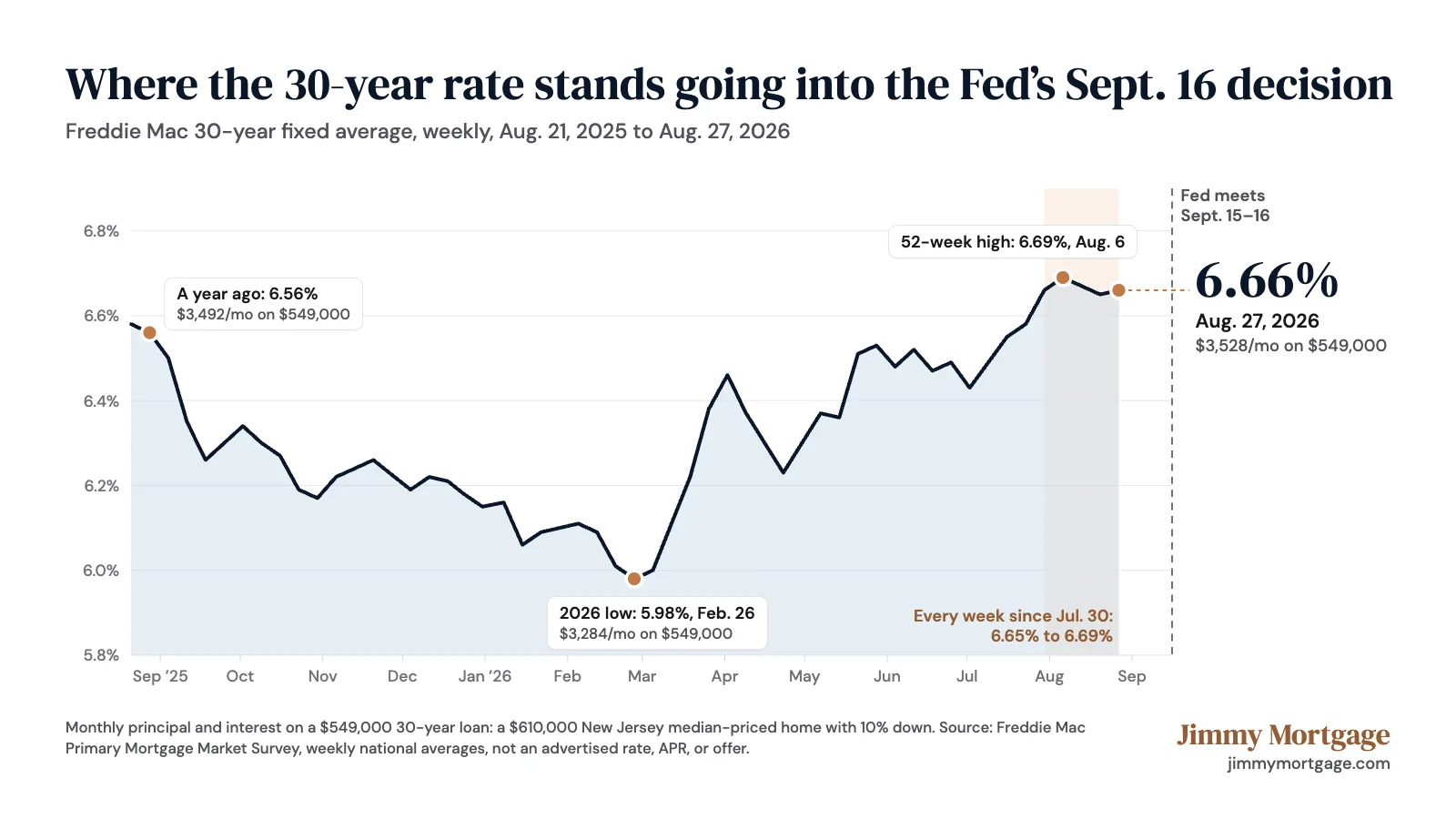
Freddie Mac 30-year average, Aug. 27
Up from 6.56% a year earlier. The 52-week high was 6.69% on Aug. 6; the 2026 low was 5.98% on Feb. 26.
66%
Futures-implied odds of a September hike
CME FedWatch reading on Aug. 31 for a quarter-point move to 3.75%–4.00%. The Fed’s range has sat at 3.50%–3.75% since December 2025.
$610,000
NJ single-family median, year to date
Up 3.7% from a year ago per NJ Realtors’ July report. Homes for sale rose 5.9% and days on market rose to 40.
Weekly Freddie Mac 30-year average, with the payment on a $549,000 loan at the 2026 low, a year ago, and the latest reading. Source: Freddie Mac PMMS history through Aug. 27, 2026.
The Freddie Mac Primary Mortgage Market Survey is a weekly national benchmark, not Jimmy’s advertised rate, an APR, or a personalized New Jersey offer. Every payment figure on this page is arithmetic on that public benchmark so the moves can be compared on equal footing. The 10-year Treasury yield, which 30-year mortgage rates track most closely, closed at 4.75% on Aug. 31.
What a Fed hike actually does to NJ mortgage rates
The Federal Reserve sets the federal funds rate, an overnight rate banks charge each other. Nobody’s 30-year mortgage is priced off it directly. Fixed mortgage rates follow the 10-year Treasury yield plus a spread, and the 10-year moves on what investors expect inflation and Fed policy to look like over the next decade. That is why mortgage rates so often move before the Fed acts, and sometimes in the opposite direction afterward.
2022: rates moved before the Fed did
On Jan. 6, 2022 the Freddie Mac 30-year average was 3.22% and the Fed's target range topped out at 0.25%. By Oct. 27, 2022 the mortgage average had reached 7.08%, while the Fed's upper bound did not hit 4.50% until Dec. 30. Mortgage rates priced the hiking cycle months ahead of the actual decisions.
Fall 2024: a Fed cut, and mortgage rates went up
The Fed cut by a half point on Sept. 18, 2024. The 30-year average was 6.09% the next day, 6.84% by Nov. 21, and 7.04% by Jan. 16, 2025. Buyers who waited for the cut to lower their rate saw the opposite.
Fall 2025: the drop arrived before the meeting
Ahead of the September 2025 meeting, the 30-year average fell from 6.56% on Aug. 28 to 6.26% on Sept. 18, 2025. Most of that move happened in the three weeks before the decision, not after it.
The practical takeaway for a New Jersey buyer: a quarter-point hike that futures already price at two-in-three odds is mostly in today’s rate sheets. What can move rates on Sept. 16 is the surprise, in either direction, and the Summary of Economic Projections released the same afternoon, which shows where officials expect rates to go through 2027. Fed Chair Kevin Warsh’s Aug. 28 Jackson Hole speech put 12-month PCE inflation at 3.7% and the six-month annualized pace at 4.1%, and said the committee’s “predominant focus right now should be on prices.” Inflation data between now and the meeting will matter more than the meeting itself.
How rates got here: the Freddie Mac weekly averages
Release date
30-year average
Note
Feb 26, 2026
5.98%
2026 low
Jul 23, 2026
6.58%
Jul 30, 2026
6.66%
Aug 6, 2026
6.69%
52-week high
Aug 13, 2026
6.67%
Aug 20, 2026
6.65%
Aug 27, 2026
6.66%
Latest release
Source: Freddie Mac Primary Mortgage Market Survey via FRED (series MORTGAGE30US). The next weekly release is Thursday, Sept. 3. Daily rate trackers moved higher on Sept. 2 on geopolitical news, so the Sept. 3 print may land above the Aug. 27 figure. For a current New Jersey reading, see theNJ mortgage rates today brief.
What a rate move costs on a median-priced NJ home
NJ Realtors’ July 2026 report puts the year-to-date single-family median at $610,000. With 10% down, that is a $549,000 loan. The table shows the monthly principal and interest on that balance over 30 years at the benchmark rates from the past year and at three hypothetical increases. Taxes, insurance, and any mortgage insurance are extra.
Scenario
Rate
Monthly P&I on $549,000
2026 low (Feb 26)
5.98%
$3,284
One year ago (Aug 28, 2025)
6.56%
$3,492
Latest Freddie Mac average (Aug 27)
6.66%
$3,528
If rates rise 0.25 point
6.91%
$3,619
If rates rise 0.50 point
7.16%
$3,712
If rates rise 1.00 point
7.66%
$3,899
A half-point rise adds about $184 a month on this loan. A full point adds about $371. Those are the stakes of the lock decision covered below, and they are also why the three structural moves that follow can matter more than trying to guess the Fed. Run your own price and down payment through themortgage calculators.
Sept. 16 simulator
Run the four moves on your own numbers
Set a price and down payment, then slide the 30-year rate to wherever you think the Freddie Mac average lands after the Fed meets. Every card below recalculates: the baseline payment, NJHMFA assistance, a seller-paid 2-1 buydown, an assumption of the seller’s loan, and what floating versus locking is worth. Principal and interest only; taxes, insurance, and mortgage insurance are on top.
6.66%
5.00%8.50%
Loan amount
$549,000
$61,000 down, 90% loan-to-value
Monthly P&I at 6.66%
$3,528
30-year fixed, before taxes and insurance
Versus today’s 6.66%
$0
per month, $0 a year
Move 1
NJHMFA down payment assistance
Down payment needed
$61,000
Assistance applied
$15,000
Your cash toward the down payment
$46,000
The assistance is an interest-free, five-year forgivable second loan with no monthly payment, so the P&I above does not change. Income and purchase-price limits, first-time-buyer status, and an NJHMFA first mortgage all apply.
Move 2
Seller-paid 2-1 buydown
2-1 buydown payment schedule at the selected rate
Period
Rate
P&I
Year 1
4.66%
$2,834
Year 2
5.66%
$3,172
Years 3 to 30
6.66%
$3,528
Seller subsidy needed
$12,593
Conventional credit cap (6%)
$36,600
Fits inside the cap with $24,007 to spare for other credits.
Cap follows Fannie Mae’s interested-party contribution limits for a primary residence: 3% above 90% loan-to-value, 6% from 75.01% to 90%, 9% at 75% or below. FHA allows 6%.
Move 3
Assume the seller’s FHA or VA loan
Assumed payment at 3.25%
$1,741
Same balance borrowed new at 6.66%
$2,571
Monthly saving from assuming
+$830
Equity gap to cover
$210,000
Assumed payment is figured on a fresh 30-year schedule; the real loan has fewer years left, which raises the payment slightly. The equity gap is cash or secondary financing you bring. The servicer must approve you, and the seller’s loan must be FHA, VA, or USDA.
Move 4
Lock now or float through Sept. 16
Payment exposure if rates move after the Fed meeting
Scenario
P&I
Per month
Rates fall 0.25 after Sept. 166.41%
$3,438
−$90
Rates hold where you set them6.66%
$3,528
$0
Rates rise 0.256.91%
$3,619
+$91
Rates rise 0.507.16%
$3,712
+$184
Nobody can tell you which row happens. The question is whether the “rise 0.50” row would push the payment past your own budget; if it would, that is the case for locking with a float-down option instead of guessing.
This simulator is for education and planning, not a Loan Estimate, commitment, approval, interest-rate offer, or disclosure. The rate presets are Freddie Mac weekly national averages, not Jimmy’s advertised rate, an APR, or a personalized New Jersey offer. NJHMFA amounts, buydown terms, contribution limits, and assumption approval are controlled by the program owner, lender, investor, servicer, and final transaction documents.
Move 1
Use NJHMFA down payment assistance while it is open
Higher rates make cash to close the tightest constraint for many first-time buyers, and New Jersey’s state housing agency still has a live answer to that. The NJHMFA Down Payment Assistance program provides up to $15,000 toward down payment and closing costs, depending on county, as an interest-free, five-year forgivable second loan with no monthly payment. The $15,000 tier covers Bergen, Essex, Hudson, Hunterdon, Mercer, Middlesex, Monmouth, Morris, Ocean, Passaic, Somerset, and Union; the remaining counties receive $10,000. Buyers who qualify as first-generation homebuyers can add a $7,000 supplement, for a total of $17,000 to $22,000.
A first-time buyer for NJHMFA purposes is someone who has not owned a home in the previous three years, and income and purchase-price limits apply by county and household size. The agency’s page does not post an application deadline, and availability is confirmed through an NJHMFA participating lender rather than by applying to the agency directly. The assistance attaches to an NJHMFA first mortgage, so the first-mortgage rate and terms need to be weighed against a conventional or FHA alternative rather than assumed to be better because of the grant-like second.
Negotiate a seller-paid 2-1 buydown instead of a price cut
The July NJ Realtors data shows more homes for sale (up 5.9%), longer marketing times (40 days, up 8.1%), and a slightly softer sale-to-list ratio (101.5%, down 0.4 points) than a year ago. Sellers are still getting list price, but they are waiting longer for it, which is the environment where a seller-funded concession becomes negotiable. A temporary buydown is one way to spend that concession.
2-1 buydown on a $610,000 NJ home, 10% down
Loan amount $549,000. Illustrative note rate 6.66%, the Aug. 27 Freddie Mac average. Full principal-and-interest payment: about $3,528.
Year one, payment at 4.66%: about $2,834. Seller subsidy: about $8,327.
Year two, payment at 5.66%: about $3,172. Seller subsidy: about $4,266.
Total seller cost: about $12,593. Year three onward, the full $3,528 payment applies and the buyer must qualify at it.
Fannie Mae caps interested-party contributions at 6% of the price for a loan-to-value between 75.01% and 90%, which is $36,600 here. Below 10% down the conventional cap drops to 3%, or $18,300, so the structure changes with the down payment. FHA allows 6% and VA allows 4% in seller concessions.
Compare that $12,593 against the same dollars as a price reduction. Cutting the price by $12,593 lowers the loan by about $11,300 at 10% down and trims the payment by about $73 a month for 30 years. The buydown delivers about $694 a month of relief in year one and $355 in year two, then nothing. Which is better depends on how long you plan to keep the loan and whether the first two years are the tightest. The full schedule, the qualification rule, and the written-agreement checklist are in theNJ buydown guide.
Move 3
Look for assumable FHA and VA loans
The Freddie Mac average bottomed at 2.65% in January 2021. Many New Jersey owners who bought or refinanced in 2020 and 2021 hold FHA or VA loans in the 2.5% to 3.5% range, and those loans are generally assumable: a qualified buyer takes over the existing note, rate, and remaining term. HUD caps the FHA assumption processing fee at $1,800, and VA charges a 0.5% funding fee on an assumption instead of the 2.15% a first-use purchase borrower pays with less than 5% down.
What a 3.25% assumption is worth against 6.66%
$400,000 balance at 3.25%: about $1,741 a month in principal and interest.
The same $400,000 borrowed new at 6.66%: about $2,571 a month.
Difference: about $830 a month, or roughly $49,800 over five years, before the lower total interest over the remaining term.
The equity gap: on a $610,000 purchase, the buyer must cover the $210,000 between the price and the $400,000 balance with cash or secondary financing. That is the constraint that decides whether an assumption is realistic.
Assumptions take servicer approval and usually more time than a standard purchase, and the seller’s agent may not have advertised the option. Ask about the seller’s loan type on every FHA- or VA-financed listing you tour. TheNJ assumable mortgage guidecovers qualification, the process, costs, and how to find candidates, and theFHA and VA program pages explain the underlying loans.
Move 4
Decide your lock strategy before Sept. 16, not after
A rate lock is a lender’s written commitment to hold a rate and points for a set period, provided the loan closes within it. The CFPB’s guidance is that the lock agreement should state the rate, the lock period, and any fees for locking or extending. What it does not tell you is whether to lock, and neither can anyone else with certainty. The three episodes above show mortgage rates falling before a Fed meeting, rising after a cut, and running ahead of hikes. A lock decision built on predicting Sept. 16 is a coin flip.
A better frame is budget risk. If you are under contract and a half-point move would push the payment past what you approved for yourself, the $184-a-month exposure in the table above is what you are insuring against, and a lock is the insurance. If you can absorb the higher payment and want to keep the chance of a lower rate, ask whether the program offers a float-down and what it costs. Either way, get three things in writing: the lock period, the cost of an extension if the closing slips, and what happens if the lock expires. If you are still shopping, a lock is not yet available; a pre-approval that stress-tests the payment a half point higher is the equivalent protection.
1Get a written pre-approval that shows the payment at today's rate and at a rate a half point higher, so a September move does not knock you out of your own budget.
2Ask whether your household fits NJHMFA's income and purchase-price limits for the county you are shopping in, and whether the First Generation supplement applies.
3Ask your agent to pull the seller's financing type on every home you tour. An FHA or VA loan in the seller's history is the first clue that an assumption might be possible.
4Before you write an offer, decide in advance which concession you would ask for: a price cut, a closing-cost credit, or a seller-funded buydown, and what each is worth to you in dollars.
5Ask the lender for the lock agreement in writing, including the lock period, the cost of an extension, and whether a float-down option exists on the program you are using.
Sources were reviewed September 2, 2026. Benchmark rates, futures pricing, and program rules change; the figures above describe the market on that date and are not a rate quote, an APR, or a commitment to lend. A complete application and lender review are required for actual terms and any approval.
Frequently asked questions
Will a Fed rate hike on Sept 16 raise my New Jersey mortgage rate?
Not automatically, and not by the same amount. The Fed sets the overnight federal funds rate. Thirty-year mortgage rates track the 10-year Treasury yield plus a spread, and both move on inflation expectations before the Fed acts. In 2022 mortgage rates rose months ahead of the Fed's hikes, and in fall 2024 they rose after a Fed cut. By the time the September decision is announced, a widely expected quarter-point hike is usually already reflected in rate sheets. The bigger risk is a surprise: a larger hike, or projections that signal more hikes ahead.
Should I wait until after the Fed meeting to lock my rate?
There is no reliable way to know whether rates will be higher or lower on Sept 17 than they are today. A rate lock is a written commitment from a lender to hold a rate for a set period if the loan closes on time. If you are under contract and your closing date falls inside a standard lock window, the question is not whether the Fed will hike but whether a higher rate would break your budget. If it would, a lock removes that risk. If you can absorb a higher payment and want to keep upside, ask whether the program offers a float-down option and what it costs. The CFPB explains rate locks in plain language, and the lock agreement should spell out the period, fees, and extension terms.
Is NJHMFA down payment assistance still available in fall 2026?
NJHMFA's program page currently lists the Down Payment Assistance program at up to $15,000 depending on county, structured as an interest-free, five-year forgivable second loan with no monthly payment, plus a $7,000 First Generation Homebuyer supplement for qualifying buyers, for a combined total of up to $22,000. The agency's page does not post an application deadline; funds and eligibility are confirmed through an NJHMFA participating lender, and income and purchase-price limits apply. Because the assistance is a second loan tied to an NJHMFA first mortgage, it should be evaluated alongside the first-mortgage rate and terms rather than on its own.
How much does a seller-paid 2-1 buydown cost on a $610,000 New Jersey home?
Using the Aug. 27, 2026 Freddie Mac 30-year average of 6.66% as an illustrative note rate, a $610,000 purchase with 10% down produces a $549,000 loan and a full principal-and-interest payment of about $3,528. A 2-1 buydown funds payments at 4.66% in year one (about $2,834) and 5.66% in year two (about $3,172). The seller's subsidy is the difference, roughly $8,327 in year one and $4,266 in year two, or about $12,593 total. Fannie Mae caps interested-party contributions at 6% of the price for a 90% loan-to-value conventional loan, which is $36,600 here, so the buydown fits inside the cap with room for other credits. The numbers are arithmetic on a public benchmark, not Jimmy's advertised rate, an APR, or an offer.
Can I take over the seller's FHA or VA loan at their old rate?
Often yes, if the servicer approves you. FHA-insured and VA-guaranteed loans are generally assumable with a creditworthiness review; USDA-guaranteed loans can be assumed with Rural Development approval, though outside family transfers the loan is re-papered on new terms. HUD caps the FHA assumption processing fee at $1,800, and VA charges a 0.5% funding fee on assumptions. The catch is the equity gap: on a $610,000 home where the seller owes $400,000, you need $210,000 in cash or secondary financing to cover the difference. When the gap is manageable, keeping a 3.25% note instead of borrowing at 6.66% saves roughly $830 a month on a $400,000 balance.
Jimmy can check NJHMFA eligibility, price a seller-paid buydown against a price reduction, review an assumption candidate, and put the lock terms in writing for the same purchase. A complete application and lender review are required for actual terms and approval.