Should I wait for mortgage rates to drop before buying a house in New Jersey?
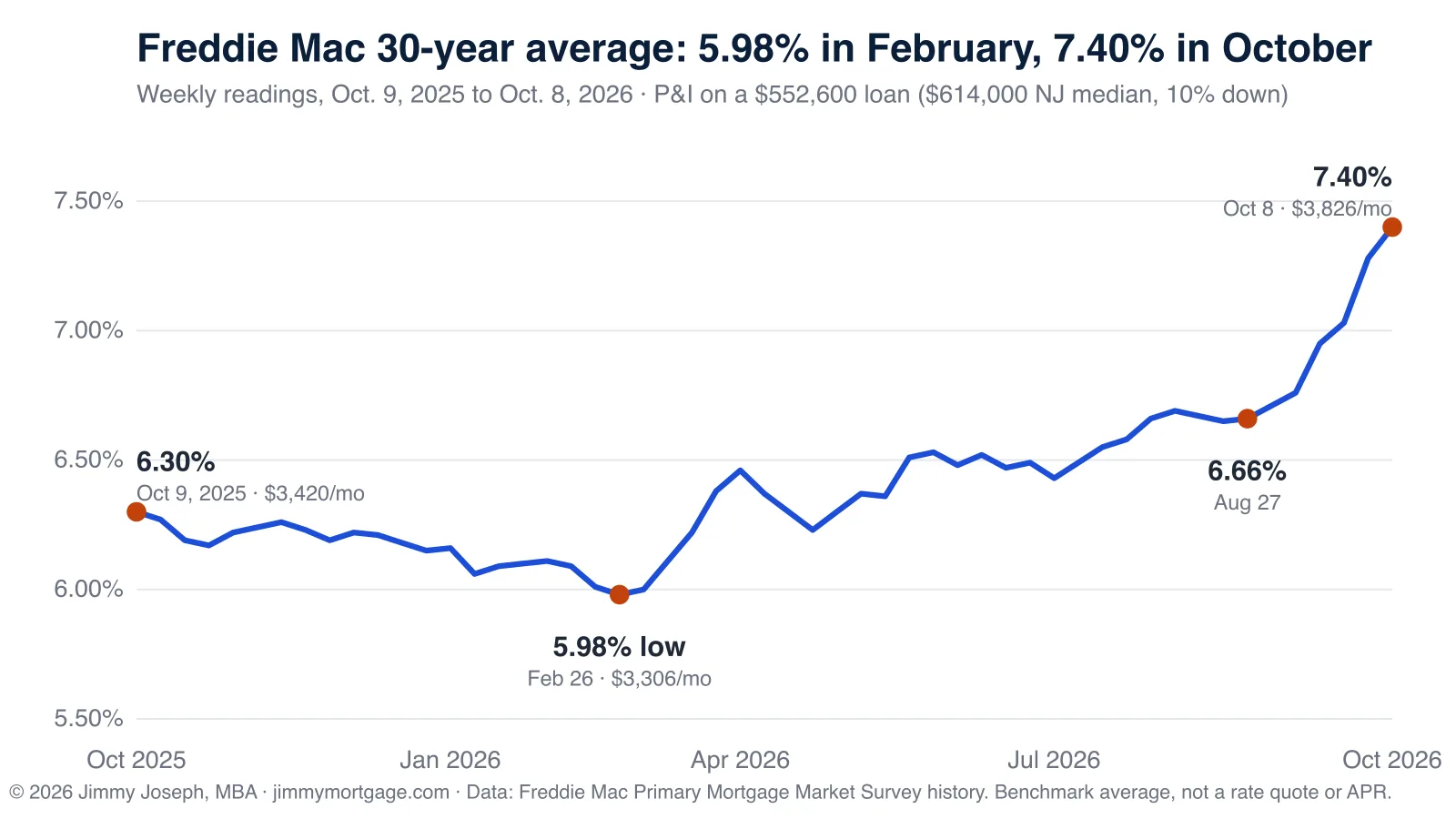
Only if your own file is not ready. Waiting for the market has a measurable record in New Jersey: a buyer who waited from the Feb. 26, 2026 low of 5.98% for a better rate now faces 7.40%, about $520 more a month on a 10%-down loan against the $614,000 single-family median, while that median rose 5.0% in a year. Nobody can promise rates fall by a given date, and when they do, more buyers come back, which is what pushed NJ sale prices to 101.8% of list in September 2026 even at 7% rates. Wait when the payment only works at today's rate, when you may move within three years, when a credit or program step is weeks away, or when closing would empty your emergency fund. Those waits have an end date you control.
What mortgage rate would make waiting a year pay off on a median NJ home?
On a $614,000 purchase with 10% down, the Oct. 8, 2026 Freddie Mac average of 7.40% gives a principal-and-interest payment of about $3,826. If prices keep rising at New Jersey's 2026 year-to-date pace of 3.4%, the same home costs $634,876 a year from now and the loan is $571,388. The rate that produces the same $3,826 payment on that larger loan is 7.06%, so rates have to fall more than a third of a point just to break even on the payment. At 6.90% the later payment is $63 a month lower; at 6.40% it is $252 lower; at the 2026 low of 5.98% it is about $408 lower. At the September pace of 5.0% price growth, the break-even rate drops to 6.91%. None of that counts a year of rent or the roughly $5,195 of principal a buyer at 7.40% pays down in the same twelve months.
Are New Jersey home prices going down in 2026?
Not in the latest statewide data. NJ Realtors' September 2026 report puts the single-family median sales price at $614,000, up 5.0% from September 2025, with the year-to-date median at $615,000, up 3.4%. What has changed is the balance: closed sales fell 6.5%, homes for sale rose 8.1% to 14,638, and months of supply moved from 2.9 to 3.1. Sellers still received 101.8% of list price on average and homes sold in 35 days, the same as a year ago. That is a market with more choice and a little more room to negotiate concessions, not one with falling prices.
Will the Fed meeting on October 27-28 lower my mortgage rate?
Not directly, and possibly not at all. The Fed sets the overnight federal funds rate; 30-year mortgage rates follow the 10-year Treasury yield plus a spread. The Fed raised its range to 3.75%-4.00% on Sept. 16, 2026, and the Freddie Mac average had already climbed from 6.66% on Aug. 27 to 6.95% on Sept. 17 and kept rising to 7.40% by Oct. 8 as the 10-year yield moved above 5%. The decision lands at 2 p.m. Eastern on Wednesday, Oct. 28. A widely expected outcome is usually already in rate sheets by then; what moves rates is a surprise in either direction and the inflation data before and after. Build the decision on whether a higher payment breaks your budget, not on predicting the meeting.
Is buying now and refinancing later a safe plan?
It is a plan with a cost and no guarantee. If you buy the $614,000 median with 10% down at 7.40%, the balance after 24 payments is about $541,813. Refinancing that balance at 6.40% into a new 30-year loan drops the payment from $3,826 to about $3,389, a $437-a-month saving, and the two years at the higher rate cost about $8,869 more than having 6.40% from the start. A refinance also carries lender, title, and prepaid costs that only a Loan Estimate can price, and it restarts a 30-year clock. The plan works if rates actually fall, if your credit and income still qualify, and if you keep the loan long enough for the savings to cover the costs. It fails if rates stay here, which is what happened to buyers who waited since February.
How do New Jersey first-time buyers lower the cost of buying at 7.4%?
Three moves on this page are built on public program rules rather than on a rate prediction. NJHMFA's Down Payment Assistance provides $15,000 in Bergen, Essex, Hudson, Hunterdon, Mercer, Middlesex, Monmouth, Morris, Ocean, Passaic, Somerset, and Union counties and $10,000 in the other nine, as an interest-free, five-year forgivable second loan, plus a $7,000 First Generation supplement for qualifying buyers, up to $22,000 in all. A seller-paid 2-1 buydown at a 7.40% note rate funds payments at 5.40% in year one and 6.40% in year two, about $13,111 of seller money on the median loan, inside Fannie Mae's 6% contribution cap of $36,840 at 10% down. And assuming a seller's FHA or VA loan at 3.25% instead of borrowing $400,000 new at 7.40% saves about $1,029 a month, if you can cover the gap between the price and the balance.
When is waiting the right decision?
When the wait is for your own file rather than for the market. Wait if a half-point rise would break your payment ceiling, because a loan that only works at today's rate is too tight. Wait if you may move within three years, because first-year principal paydown at 7.40% is only about $5,195 on the median loan and transaction costs come out of a short hold. Wait if a credit score band, a work-history rule, or NJHMFA's first-time-buyer three-year rule resets soon. And wait if closing would empty the reserve that covers a furnace or a job gap on a home whose property tax bill sits near New Jersey's $10,570 average. Each of those has a date you control; a rate target does not.